

BNC Adapters: Types, Structure, and Uses Explained
What are BNC Adapters?
Tyclon’s BNC adapters provide a reliable solution for connecting BNC connectors or transitioning between BNC and other RF interfaces. Engineered with precision and durability, they ensure consistent performance across a wide range of RF and microwave applications. Available in various configurations—including BNC-to-BNC and BNC-to-other connector types—our adapters support seamless integration in test systems, instrumentation, and communication equipment.
50 Ohm vs. 75 Ohm
50 Ohm is specialized for radio/data transmission (power transfer), while 75 Ohm is optimized for broadcast/video transmission (minimal loss). Connecting different impedances causes reflection, making it essential to match the system impedance, especially above 200 MHz.
Mating of BNC Connectors

The BNC connector uses a bayonet lock system that connects and locks with a simple quarter-turn motion. This design makes it ideal for quick connections in CCTV, video, audio, antenna, and network applications.
BNC connectors mate through male and female openings, securely joining their center contacts. Adapters are available in various configurations, including male-to-male, female-to-female, and male-to-female. Some designs also feature connectors with three mating interfaces to support more complex connections.
BNC Adapters by Type
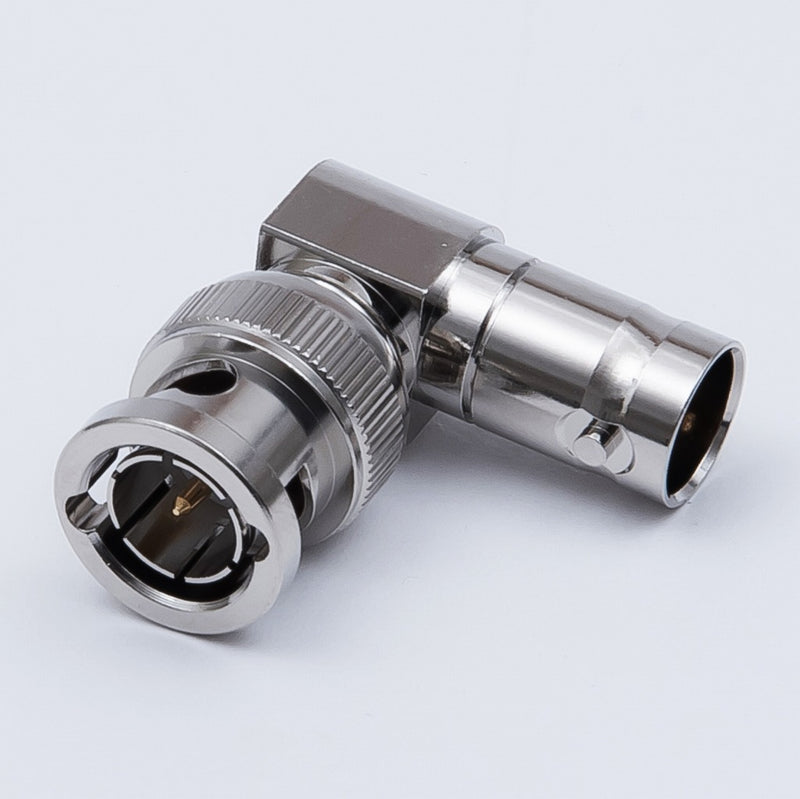
A BNC adapter is a connector with male or female BNC interfaces at both ends. It is used for purposes such as extending, interconnecting, or branching connectors. Unlike cables, these adapters directly link connectors together without requiring a cable assembly. A variety of connector shapes are available to suit your specific application.




Examples of BNC Adapter Usage

Different connector combinations and adapter types make BNC connectors versatile for a wide range of applications.
BNC Conversion Connectors
Among adapters, those with different connector types on each end are called conversion adapters. This is used when you need to transition between a BNC connector and another type of connector.
BNC Adapter FAQs
QWhat is a BNC adapter?
QWhat is a BNC adapter?
A BNC adapter is a coaxial connector device that converts or bridges interfaces between BNC male and female types. It ensures signal continuity across mismatched connectors.
QWhat is the primary function of a BNC adapter in a coaxial system?
QWhat is the primary function of a BNC adapter in a coaxial system?
BNC adapters serve a crucial role in coaxial cable setups by facilitating the connection, extension, or intermediate linking of two separate BNC connectors. They are essential components for managing signal paths without requiring cable termination.
QHow does a standard BNC adapter connect or relay two coaxial lines?
QHow does a standard BNC adapter connect or relay two coaxial lines?
An adapter is a specialized connector designed to bridge two BNC openings, whether male or female, enabling coaxial equipment to be extended or joined. They connect solely to other connectors, offering flexibility in system configuration.
QWhat connection mechanism do BNC adapters utilize to ensure signal integrity?
QWhat connection mechanism do BNC adapters utilize to ensure signal integrity?
BNC adapters exclusively connect BNC connectors to one another using the secure bayonet lock mechanism. This method ensures a swift and dependable engagement between the central contacts, maintaining excellent signal integrity across the connection point.
QCan you describe the operation of the BNC bayonet lock system?
QCan you describe the operation of the BNC bayonet lock system?
The bayonet lock system is a quick-disconnect coupling mechanism employed by BNC connectors and adapters. It involves a simple twisting and locking motion, which provides mechanical stability and a reliable electrical connection, often referred to as mating.
QWhat are the typical configurations and uses for a straight adapter?
QWhat are the typical configurations and uses for a straight adapter?
Straight adapters are designed for collinear connection, extending the effective length of a coaxial path or joining two connector ends of the same or opposite polarity. Common types include male-to-male and female-to-female configurations.
QIn what situations would a system designer choose a Right-Angle adapter?
QIn what situations would a system designer choose a Right-Angle adapter?
Right-angle adapters change the direction of the coaxial connection by ninety degrees. This is particularly useful in tight spaces or for routing cables neatly alongside equipment, usually featuring a male-to-female pairing.
QWhat is the specific purpose of using a bulkhead adapter?
QWhat is the specific purpose of using a bulkhead adapter?
Bulkhead adapters are engineered for mounting through a panel or enclosure wall, securely isolating the internal circuitry from external connections. They provide a stable, fixed point for connecting cables on both sides of a chassis or enclosure.
QHow do panel adapters differ from other fixed mounting adapter types?
QHow do panel adapters differ from other fixed mounting adapter types?
Panel adapters are similar to bulkhead types but focus on providing a secure, fixed BNC port on the face of a control panel or instrument casing. They offer easy access for system interfacing and are vital for organized installations.
QWhen are T-Adapters necessary in a system design?
QWhen are T-Adapters necessary in a system design?
T-shape adapters are a type of branching connector used to split a single coaxial signal path into two separate paths. They allow for the simultaneous connection of three BNC ports, facilitating simple, passive signal distribution or testing setups.
QWhat advantage does a Y-adapter offer over a T-shape branching adapter?
QWhat advantage does a Y-adapter offer over a T-shape branching adapter?
Y-adapters also enable signal branching, similar to the T-shape, but their angled design can sometimes provide better strain relief or a more compact fit in specific layouts. They are crucial for creating split-signal cable management systems.
QWhy are insulated adapters necessary in some specialized electronic environments?
QWhy are insulated adapters necessary in some specialized electronic environments?
Insulated adapters feature an internal design that prevents the common connection points from touching any surrounding conductive surfaces or chassis ground. This isolation is critical for applications where ground loops or unwanted electrical noise must be avoided.
QHow do conversion connectors expand the utility of BNC systems?
QHow do conversion connectors expand the utility of BNC systems?
Conversion connectors are a subset of adapters that change a BNC termination to another coaxial connector style, such as N-type or SMA. They are indispensable for interoperability, allowing dissimilar equipment to connect seamlessly for data or video transmission.
QHow can I order BNC adapters, and what support do you offer?
QHow can I order BNC adapters, and what support do you offer?
Ordering is simple—you can purchase our BNC adapters directly on our website or contact our sales team for assistance. We also provide comprehensive technical support, including datasheets, CAD models, and application notes, to help you select the ideal connector for your project.
Purchase Guide
Tyclon coaxial connectors and processed coaxial cable products can be purchased directly online using a variety of credit cards.