

N 50 Ohm RF Connectors Guide: Types, Features, and Applications
What are N 50 Ohm RF Connectors?
N-type RF connectors are robust, medium-sized coaxial connectors primarily designed for 50 Ohm impedance, providing reliable performance up to 11–12 GHz. Their threaded coupling mechanism ensures a secure, vibration-resistant, and weatherproof connection.
They are widely used in RF communication systems operating in the UHF and microwave frequency ranges.
UHF (Ultra High Frequency) typically covers frequencies from 300 MHz to 3 GHz and is commonly used in broadcasting, mobile communications, and radio systems.
This makes N connectors ideal for outdoor and high-reliability applications such as radio communications, test equipment, and broadcast systems.
Note that incompatible 75 Ohm versions also exist.
Trivia: The Origin of N
The N connector, foundational in RF applications, was invented in the 1940s by Paul Neal at Bell Laboratories in the United States. Contrary to the common belief that it stands for 'Navy', the 'N' in its name actually comes directly from the first initial of its inventor, Neal.
This design was a significant advancement, being one of the earliest connectors capable of handling microwave frequencies effectively. Sometimes, to prevent mix-ups with the M connector type, it is colloquially known as the Nancy connector.
Browse N 50 Ohm RF Connectors by Type
Find N50 Ohm RF connectors by type and quickly navigate to the right product category.
Can't find the right N50 Ohm RF connector? We're here to help.


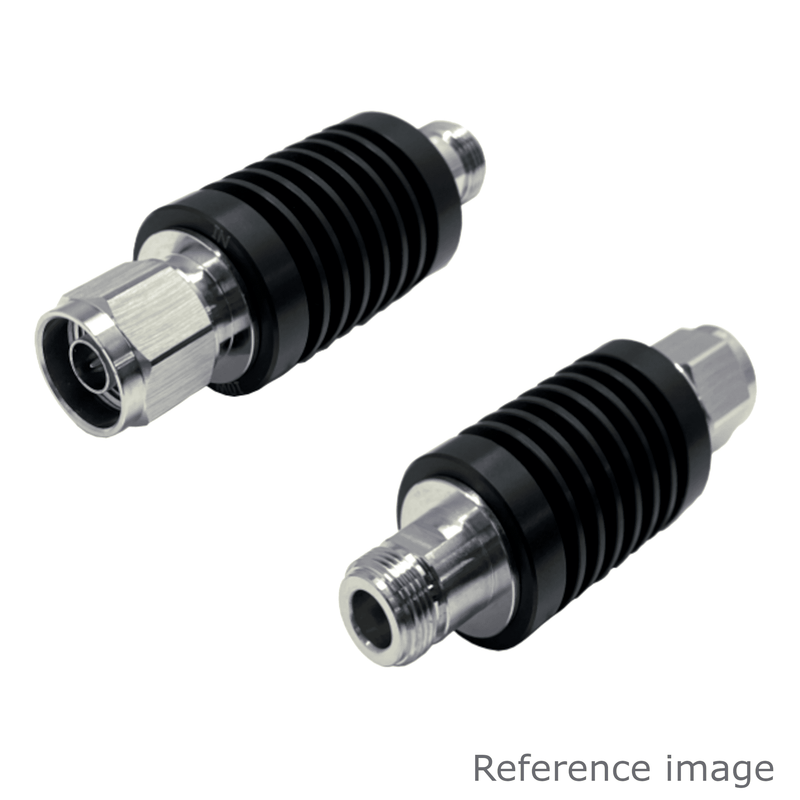


Semi-Flexible
Semi-Rigid
Trivia: Compatible Cable Types
- MIL-Standard Coaxial Cables
Compliant with US military standards for cables. Begins with the initials "RG" and is also called Mil-Spec.
- Semi-Flexible Coaxial Cables
With moderate flexibility, these cables can bend and hold their shape while offering strong shielding and low signal loss, making them ideal for precise routing in telecommunications, test equipment, and internal electronics.
- Semi-Rigid Coaxial Cables
Made from a seamless metal tube, these cables provide superior shielding and minimal signal loss. Their rigid design ensures stable performance in critical applications like military systems, high-frequency instruments, aerospace, and microwave assemblies.
N RF Connector Features
Large and Durable Design
N RF connectors are larger than many other RF connector types, which allows for a more robust and mechanically stable structure.
The threaded coupling mechanism provides a secure connection that resists loosening due to vibration or environmental stress.
This durability makes N connectors well-suited for outdoor installations, base stations, and industrial environments where reliability is critical.
Trivia: Coaxial Cable Thickness
The thickness of coaxial cables affects their flexibility and performance. Thicker cables are less flexible but offer improved performance, including lower noise and reduced signal loss. For longer cable runs, thicker cables are preferred, as they maintain signal integrity better than thinner cables, especially in demanding environments.
Secure Threaded Coupling
N RF connectors use a threaded coupling mechanism that ensures a firm and stable connection.
Unlike push-on or bayonet types, the screw-on design prevents accidental disconnection and maintains consistent contact even in environments with vibration or movement.
This secure connection makes N connectors especially suitable for outdoor installations, base stations, and industrial applications where reliability is essential.
50 Ohm vs 75 Ohm RF Impedance Differences
N RF connectors are available in both 50 Ohm and 75 Ohm impedance types, each suited for different applications.
50 Ohm connectors are commonly used in RF communication systems, wireless networks, and test equipment, where power handling and signal integrity are critical. 75 Ohm connectors are typically used in video transmission and broadcast applications.
Selecting the correct impedance is essential to minimize signal reflection and ensure optimal system performance. Note that 50 Ohm and 75 Ohm connectors are not interchangeable.
N RF Connector Applications
N RF connectors are widely used in applications that require reliable performance, high power handling, and durability in demanding environments.
Typical applications include:
- Mobile communication base stations and wireless infrastructure
- Broadcast and RF transmission systems
- Test and measurement equipment
- Industrial and outdoor communication systems
- Radar and defense-related applications
Thanks to their threaded coupling and robust construction, N connectors are especially suitable for outdoor installations and environments subject to vibration, moisture, and temperature variations.
Their stable electrical performance up to GHz ranges makes them a reliable choice for both professional and industrial RF systems.
How to Choose N RF Connectors
When selecting an N RF connector, consider the following key factors:
1. Select Impedance (50 Ohm or 75 Ohm)
Choose 50 ohm for RF communication and general applications, and 75 ohm mainly for video and broadcast systems.
2. Connector Type (Plug / Jack / Receptacle)
Select the appropriate interface type based on your equipment and installation requirements.
3. Cable Compatibility
Ensure the connector matches the cable type and size, such as RG-series coaxial cables.
4. Installation Environment
For outdoor or harsh environments, choose connectors with durable materials and a secure threaded coupling for stable performance.
5. Compare with SMA Connectors
If your application requires a smaller size or higher frequency performance, SMA connectors may be more suitable. However, for higher power handling, durability, and outdoor use, N connectors are typically the better choice.
N vs M RF Connectors
N and M RF connectors are both used in RF communication systems, but they differ significantly in performance and design.
M connectors (UHF connectors) are an older design and are mainly used in lower-frequency applications.
They do not maintain a constant impedance, which limits their performance at higher frequencies.
N connectors are designed for modern RF systems, offering a consistent 50-ohm impedance and support for higher frequencies (typically up to 11 GHz or more).
They also provide better sealing and durability, making them suitable for outdoor and high-reliability applications.
In summary, M connectors are suitable for basic, low-frequency use, while N connectors are preferred for higher-frequency and outdoor RF systems.
N RF Connector Standards & Technical Specifications
Equivalent Standards (Compatible Standards)
Complies with military standard MIL-C-39012 and JIS C 5411.
Nominal Impedance
Impedance rating is 50 Ohm, indicating compatibility with most standard RF equipment.
Coupling Mechanism (Connector Interface)
Connectors securely join using threaded coupling (5/8-24UNEF-2A, 2B) for stable signal transmission.
Voltage Rating
Rated for standard operating voltage of up to AC 500 volts.
Withstanding Voltage
Safely withstands up to AC 1,000 volts for one minute without electrical breakdown.
Insulation Resistance
Minimum insulation resistance of 1,000 megohms when tested with DC 500 volts, ensuring electrical safety.
Contact Resistance
Maximum contact resistance of 3 milliohms when conducting DC current of 1 amp, ensuring efficient connection.
Frequency Range
Suitable for signals within frequency range from 0 to 10,000 MHz.
Voltage Standing Wave Ratio (VSWR)
Maintains optimal signal quality with a maximum V.S.W.R. of 1.2 within the frequency range of 0–4,000 MHz.
Materials
Constructed from durable brass for long-lasting use in demanding environments.
Surface Treatment
Features nickel plating, ternary plating, and silver plating for corrosion resistance.
Wiring Method
Supports soldering, crimping, and clamping methods for flexible installation options.
Note: The figures provided are typical values. For further details, please contact us.
N RF Connector FAQs
QCan 50 Ohm and 75 Ohm types be combined?
QCan 50 Ohm and 75 Ohm types be combined?
No. Although 50 Ohm N connectors are available for 75 Ohm cables, they cannot be used together with 75 Ohm N connectors.
> N75 Ohm
QIs there a way to reduce the cost of a cable assembly?
QIs there a way to reduce the cost of a cable assembly?
You can opt for connectors with crimp-type cable attachments. These are lighter and more affordable than clamping-type connectors, though crimping tools are required for assembly.
QDo you offer products with stronger cable-connector connections?
QDo you offer products with stronger cable-connector connections?
Yes, clamping-type connectors provide a stronger connection than crimp types. The "Z" series uses a triple chuck method for a secure connection, while the "X" series is soldered for added strength.
QAre there any products that allow easy insertion and removal of connectors without screws?
QAre there any products that allow easy insertion and removal of connectors without screws?
Quick adapters allow easy push-pull connection and disconnection without screws. To use them efficiently, insert and remove them straight, not at an angle.
QWhat is a flare tool?
QWhat is a flare tool?
A flaring tool widens the outer sheath of a cable to aid connector installation. It’s not needed for standard coaxial cables but is essential for harder EM cables, which require spreading before connection.
QDo you offer waterproof connectors?
QDo you offer waterproof connectors?
Yes, we offer N-type waterproof connectors. The IP rating varies by product, with options including waterproofing for the mating part, cable attachment, and O-ring seals for panel mounting.
QHow do I choose the right N connector for my application?
QHow do I choose the right N connector for my application?
To select the correct N connector, consider the impedance, frequency, and environmental conditions of your application. Our team can assist with tailored recommendations.
QCan I use N connectors with other cable types?
QCan I use N connectors with other cable types?
N connectors are designed for use with coaxial cables. Ensure the cable's impedance matches the connector type (e.g., 50 Ohm or 75 Ohm) for optimal performance.
QAre there any special handling instructions for N connectors?
QAre there any special handling instructions for N connectors?
N connectors should be handled carefully to avoid damage to the cable or connector threads. Ensure the connectors are securely tightened to prevent signal loss.
QWhat tools do I need for installing N connectors?
QWhat tools do I need for installing N connectors?
Installation of N connectors typically requires specific tools depending on the connector type you choose. These can include crimping tools, clamping tools, or a soldering iron.
QHow can I order N RF connectors, and what support do you offer?
QHow can I order N RF connectors, and what support do you offer?
Ordering is simple—you can purchase our N RF connectors directly on our website or contact our sales team for assistance. We also provide full technical support, including datasheets, CAD models, and application notes, to help you pick the perfect connector for your project.
Purchase Guide
Tyclon coaxial connectors and processed coaxial cable products can be purchased directly online using a variety of credit cards.

Catalog
N RF Connector Catalog
Registration is required only for first-time users.