

2.4 mm RF Connectors Guide: Types, and Structure
What are 2.4 mm RF Connectors?
The 2.4 mm RF connector is a high-performance miniature connector designed for frequencies up to 50 GHz. It features a 50 Ohm impedance and a precision threaded coupling mechanism for stable and repeatable connections.
It is mechanically compatible with 1.85 mm (V-type) connectors, but not compatible with 2.92 mm (K-type), 3.5 mm, or SMA connectors.
2.4 mm RF Connector Compatibility with 1.85 mm V Connectors
2.4 mm RF connectors are mechanically compatible only with 1.85 mm (V-type) connectors,
and not with 2.92 mm (K), 3.5 mm, or SMA connectors.
They use an air-dielectric design and precise thread coupling to maintain stable performance
up to 50 GHz.
Because of tighter mechanical tolerances, inter-mating with incompatible connector types
can lead to damage or measurement errors.
Adapters between 2.4 mm and other connector series are available for safe conversion when needed.
Improper mating may result in permanent damage to the connector interface.
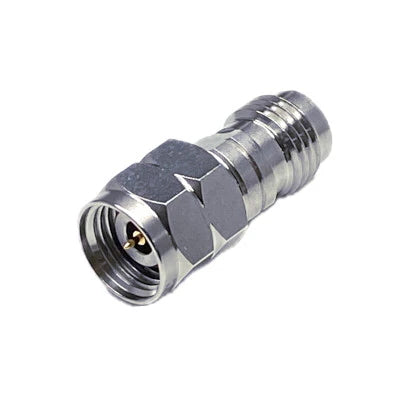
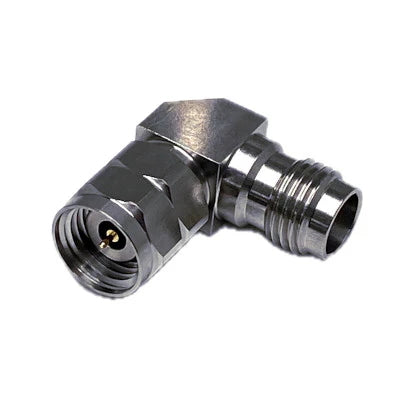
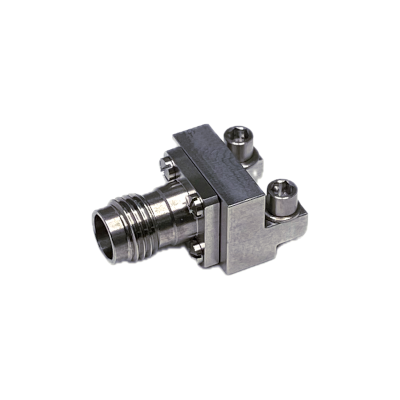
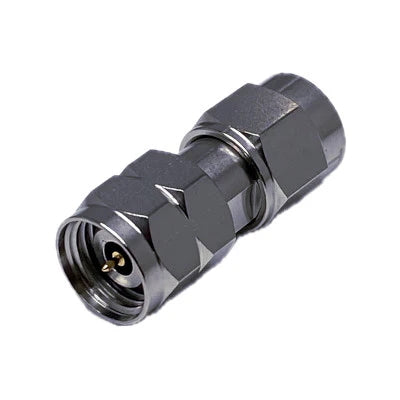
Browse 2.4 mm RF Connectors by Type
Find 2.4mm RF connectors by type and quickly navigate to the right product category.
Can't find the right 2.4mm RF connector? We're here to help.

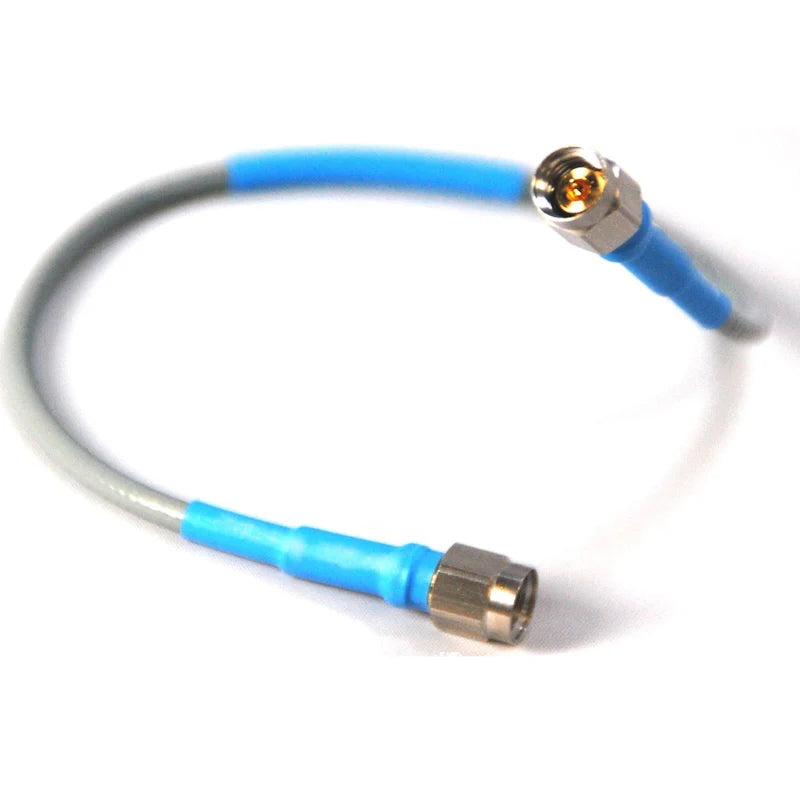
Find High-Frequency Test Cables (Up to 50 GHz)
We offer high-frequency measurement cables with 1.85 mm V connectors, compatible with other connectors such as SMA. Please refer to the product page for specifications.
TC-120 50 GHz Compatible
TC-120 is a high-end, 50 GHz compatible, low-loss, high-phase stability precision cable featuring triple shielding, bend resistance, and temperature stability—ideal for network analysis and other measurement applications.
Connectors are available in 2.4 mm (plug and jack), 2.92 mm K (plug and jack), and SMA (plug and jack) types. A non-magnetic 1.85 mm V-type (plug and jack) is also available, with a frequency limit of 50 GHz.
In addition to the standard type, an armored version with stainless steel tube reinforcement is offered.
For detailed cable specifications, electrical characteristics, and additional information, please refer to the pages listed below.
Request Custom Semi-Rigid Cable Solutions
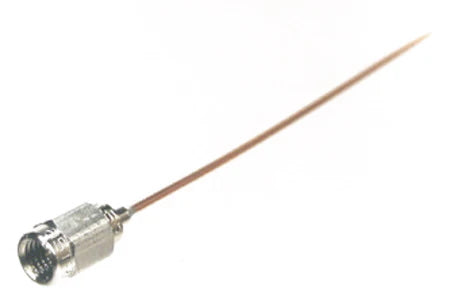
Semi-rigid cables with 2.4 mm V connectors are available and can be paired with other connectors, including SMA. Please refer to the product page for specifications.
0.047-inch SR-003 Semi-Rigid RF Cables
A semi-rigid RF cable equivalent to 0.047 inches. Offers a wide range of compatible connectors.
For detailed cable specifications, electrical characteristics, and more, please refer to the pages below.
2.4 mm RF Connector Features
High-Frequency Performance
2.4 mm RF connectors are designed for stable operation up to 50 GHz, making them suitable for high-frequency testing and measurement applications.
They feature an air-dielectric structure, which reduces dielectric loss compared to traditional PTFE-based designs, enabling improved signal integrity at higher frequencies.
The larger outer conductor compared to SMA-type connectors helps improve impedance stability and reduce signal loss at higher frequencies.
Compatibility with 1.85 mm (V) Connectors
2.4 mm connectors are mechanically compatible with 1.85 mm (V-type) connectors, allowing flexible use in mixed high-frequency test systems.
However, due to tight mechanical tolerances, improper mating or repeated use with different connector types may lead to wear or damage.
They are not compatible with SMA, 3.5 mm, or 2.92 mm (K-type) connectors.
Compact Design for High-Density Applications
Despite supporting frequencies up to 50 GHz, 2.4 mm connectors maintain a compact form factor.
This enables:
High-density mounting in limited spaces
Efficient layout in RF modules and test equipment
Reduced footprint without compromising performance
They are well suited for applications where both size constraints and high-frequency performance are critical.
2.4 mm RF Connector Applications
2.4 mm RF connectors are widely used in high-frequency applications where stable performance and precise signal transmission are required. With support for frequencies up to 50 GHz and compatibility with 1.85 mm (V-type) connectors, they are well suited for advanced RF testing and measurement environments.
Typical applications include:
Network analyzers and high-frequency measurement systems
RF test setups and laboratory equipment
Satellite and aerospace communication systems
Military and defense RF applications
Precision RF modules and high-frequency signal transmission systems
These connectors are ideal for applications where signal integrity, repeatability, and mechanical precision are critical.
RF Connector Frequency Comparison
The following RF connectors are commonly used in high-frequency applications, each with different frequency ranges and characteristics.
1.0 mm: Up to 110 GHz
1.85 mm (V): Up to 67 GHz
2.4 mm: Up to 50 GHz
2.92 mm (K): Up to 40 GHz
3.5 mm: Up to 34 GHz
SMA: Up to 18 GHz
Higher-frequency connectors offer better performance but typically require more careful handling and precise alignment.
How to Choose 2.4 mm RF Connectors
Selecting the right 2.4 mm RF connector requires careful consideration of frequency performance, compatibility, and application requirements. Follow the points below to ensure reliable and stable high-frequency connections.
1. Confirm Frequency Requirements
2.4 mm connectors are designed for high-frequency applications up to 50 GHz.
Ensure the connector supports your operating frequency range
Use high-performance connectors for measurement and test environments
Avoid using lower-grade alternatives that may degrade signal integrity
2. Check Compatibility with 1.85 mm (V) Connectors
2.4 mm connectors are mechanically compatible with 1.85 mm (V-type) connectors.
Suitable for mixed-interface test setups
Ensure proper handling to avoid wear or damage
Avoid repeated mating cycles with different connector types
3. Verify Cable and Assembly Requirements
Select connectors that match your cable type and assembly method.
Confirm compatibility with semi-rigid or test cables
Check cable diameter and structure
Choose between standard or custom cable assemblies
4. Consider Application Environment
Choose connectors based on how and where they will be used.
Ideal for high-frequency testing and measurement systems
Suitable for precision RF applications
Not intended for low-cost or general-purpose use
1.85 mm (V) vs 2.4 mm vs 2.92 mm (K) RF Connectors
1.85 mm (V), 2.4 mm, and 2.92 mm (K) RF connectors differ mainly in frequency performance and compatibility.
1.85 mm supports up to 67 GHz and is designed for high-precision applications.
2.4 mm supports up to 50 GHz and provides improved durability due to its larger outer conductor.
2.92 mm supports up to 40 GHz and is compatible with SMA and 3.5 mm connectors, offering greater flexibility.
1.85 mm is best for high-frequency precision, 2.4 mm for durability, and 2.92 mm for compatibility and ease of use.
2.4 mm V RF Connector: Standards & Technical Specifications
Compatible Standards
Complies with international standard IEC 61169-40.
Nominal Impedance
Impedance rating is 50 Ohm, indicating compatibility with most standard RF equipment.
Coupling Method (Connector Interface)
Connectors securely join using threaded coupling M7 P0.75-6H, 6g for stable signal transmission.
Working Voltage (Rated Voltage)
Rated for standard operating voltage of up to 160 V AC.
Maximum Withstanding Voltage
Safely withstands up to 500 V AC for one minute without electrical breakdown.
Insulation Resistance
Minimum insulation resistance of 1,000 MΩ when tested with 500 V DC, ensuring electrical safety.
Contact Resistance
Maximum contact resistance of 4.0 mΩ (center) and 2.5 mΩ (outer) when conducting DC current of 1 A, ensuring efficient connection.
Frequency Range
Suitable for signals within frequency range from DC to 50 GHz.
2.4 mm RF Connector FAQs
QWhat is the difference between 2.4 mm and SMA connectors?
QWhat is the difference between 2.4 mm and SMA connectors?
The 2.4 mm V connector features a 2.4 mm outline by replacing the Teflon insulator with air, allowing for a higher waveguide mode cutoff frequency and supporting an operating range from DC to 50 GHz. The SMA, 3.5 mm, and 2.92 mm K connectors have similar shapes but are not compatible, while the 1.85 mm connector is mated.
> SMA
> 3.5 mm
> 2.92 mm K
> 2.4 mm
QAre there connectors with even higher frequency and smaller size?
QAre there connectors with even higher frequency and smaller size?
Our lineup includes 1.0 mm connectors, supporting frequencies up to 110 GHz, and 1.85 mm V connectors, supporting frequencies up to 67 GHz. Explore our 1.0 mm connectors and 1.85 mm V connectors for more details.
QWhat frequency range does the 2.4 mm connector support?
QWhat frequency range does the 2.4 mm connector support?
The 2.4 mm connector is designed for reliable performance from direct current up to 50 GHz, making it ideal for wideband and high-frequency applications.
QWhat is the standard impedance of the 2.4 mm connector?
QWhat is the standard impedance of the 2.4 mm connector?
The 2.4 mm RF connector has a standard impedance of 50 Ohm, ensuring compatibility with most radio frequency test systems and instruments.
QWhat type of coupling mechanism does it use?
QWhat type of coupling mechanism does it use?
It uses a threaded coupling interface with M7 P0.75-6H, 6g specifications to provide secure, repeatable connections under high-frequency conditions.
QWhat is the rated working voltage?
QWhat is the rated working voltage?
The 2.4 mm connector is rated for an operating voltage of up to alternating current 160 V, suitable for standard laboratory and test environments.
QHow much voltage can the connector withstand?
QHow much voltage can the connector withstand?
It can withstand up to alternating current 500 V for one minute without breakdown, meeting safety and durability standards for testing environments.
QWhat is the insulation resistance?
QWhat is the insulation resistance?
The connector offers a minimum insulation resistance of 1,000 MΩ when tested at direct current 500 Ω, maintaining high electrical safety.
QCan it be mated with other connector types?
QCan it be mated with other connector types?
It cannot be mated with SMA, 3.5 mm, or 2.92 mm connectors due to different mechanical dimensions. It is only intermateable with 1.85 mm connectors.
QWhat standards does the 2.4 mm connector comply with?
QWhat standards does the 2.4 mm connector comply with?
This connector complies with IEC 61169-40, ensuring global compatibility and adherence to internationally recognized connector standards.
Purchase Guide
Tyclon coaxial connectors and processed coaxial cable products can be purchased directly online using a variety of credit cards.