
M RF Connectors Guide: Types, Structure, and Uses Explained
What are M RF Connectors?
The M RF connector is a type of coaxial connector designed for applications where strict impedance matching is not required. This makes it a cost-effective and practical choice for low-frequency signal transmission.
Unlike precision RF connectors such as SMA or N type, M connectors feature a simpler structure, which contributes to their durability and ease of handling.
They are typically used in frequency ranges below 200 MHz and are widely found in applications such as amateur radio, basic communication systems, and legacy RF equipment.
Browse M RF Connectors by Type
Find M RF connectors by type and quickly navigate to the right product category.
Can't find the right M RF connector? We're here to help.


Trivia: Compatible Cable Types
- MIL-Standard Coaxial Cables
These cables, also known as Mil-Spec, are engineered to meet rigorous US military specifications for performance and durability. They often feature the "RG" prefix, which stands for "Radio Guide," reflecting their roots in radio technology. They are critical in demanding applications like defense, aerospace, and telecommunications, where reliability is non-negotiable.
M RF Connector Features
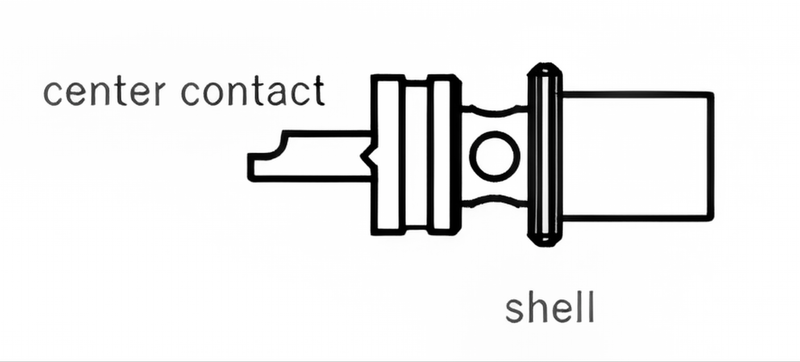
Combined center contact and shell
Unlike standard RF connectors, the M connector does not have a separate center contact pin. Instead, the signal path is integrated into the connector body (shell), resulting in a simplified structure.
This design offers several advantages:
Fewer components, leading to improved mechanical robustness
Reduced manufacturing cost
Easier handling during installation
However, because the center conductor is not independently controlled, precise impedance matching is not possible. This is why M connectors are mainly used in low-frequency applications.
Detachable Solder Type
M connector plugs and jacks are available in detachable solder-type designs, allowing the outer shell to be removed during assembly.
This feature provides:
Easier soldering access to the conductor
Improved workability during cable assembly
Simplified maintenance and rework
It is especially useful in custom cable fabrication and small-batch production environments.
Simple and Robust Structure
M RF connectors feature a simple mechanical design with fewer internal components compared to precision RF connectors.
This results in:
High durability in everyday use
Resistance to mechanical stress
Easy handling without delicate alignment
This makes them suitable for environments where ruggedness is more important than high-frequency performance.
M RF Connectors Applications
M RF connectors are commonly used in low-frequency applications where strict impedance control is not required. Their simple structure, durability, and ease of handling make them a practical choice for cost-sensitive and stable signal transmission environments.
Typical applications include:
Amateur radio (HF / VHF communication)
Basic communication equipment
Legacy RF systems and maintenance applications
Low-frequency signal transmission systems
How to Choose M RF Connectors
Selecting the right M RF connector depends on your application, cable type, and required electrical performance. Follow the steps below to ensure proper compatibility and reliable signal transmission.
1. Check Connector Type
Start by identifying the required connector form for your system.
Plug (Male): Used to connect into a jack interface
Jack (Female): Panel-mounted or cable-mounted receptacle
Adapters: Used to connect different connector types or genders
Choose the type based on how the connector will interface with your equipment.
2. Confirm Cable Compatibility
Ensure the connector matches your cable specifications.
Check cable diameter and structure
Verify compatibility with coaxial cable types used in your system
Confirm whether the connector supports your cable’s shielding and construction
A mismatch may result in poor electrical performance or installation issues.
3. Verify Electrical Requirements
Match the connector to your system’s electrical conditions.
Frequency range: Ensure the connector supports your operating frequency
Impedance: Typically 50 ohms (confirm your system requirement)
Voltage rating: Confirm it meets your application’s voltage conditions
This is critical for maintaining signal integrity and preventing loss.
4. Consider Installation Method
Choose a connector type that fits your assembly process.
Solder type: Suitable for secure and permanent connections
Clamp or crimp type: Easier and faster installation
Panel-mount options: Required for fixed equipment interfaces
Select based on your manufacturing process and maintenance needs.
M Type RF Connector: Standards & Technical Specifications
Compatible Standards
Complies with industry standard JIS C 5419.
Nominal Impedance
Impedance rating is non-matching, indicating it is not suitable for high-frequency applications.
Coupling Method (Connector Interface)
Connectors securely join using threaded coupling M16-P1 for stable signal transmission.
Working Voltage (Rated Voltage)
Rated for a standard operating voltage of up to 500 V ac.
Maximum Withstanding Voltage
Safely withstands up to AC 1000 V ac for one min without electrical breakdown.
Insulation Resistance
Minimum insulation resistance of 1,000 mΩ when tested with 500 V DC, ensuring electrical safety.
Contact Resistance
Maximum contact resistance of 3 mΩ when conducting DC current of 1 amp, ensuring efficient connection.
Frequency Range
Suitable for signals within the frequency range from 0 to 200 MHz (0.2 GHz).
Note: The figures provided are typical values. For further details, please contact us.
M RF Connector FAQs
QIs impedance matching achieved?
QIs impedance matching achieved?
The M connector has mismatched impedance, making it unsuitable for high-frequency applications above 200 MHz. Impedance mismatch occurs even with conversion connectors.
QIn what situations is it mainly used?
QIn what situations is it mainly used?
M connectors are commonly used in low-frequency applications, including amateur radio and other devices operating under 200 MHz.
QWhat is the frequency range of M connectors?
QWhat is the frequency range of M connectors?
M connectors are designed for use in the frequency range of 0 to 200 MHz, making them ideal for low-frequency applications rather than high-frequency systems.
QWhat is the working voltage of M connectors?
QWhat is the working voltage of M connectors?
The standard working voltage for M connectors is up to 500 V ac alternating current, ensuring reliable performance in low-frequency applications.
QWhat is the maximum voltage rating for M connectors?
QWhat is the maximum voltage rating for M connectors?
M connectors can safely withstand up to 1,000 V ac alternating current for one min without experiencing electrical breakdown, ensuring durability and safety.
QWhat are the key features of M connectors?
QWhat are the key features of M connectors?
M connectors have an integrated center contact and shell, and some models include a detachable solder type, allowing the shell to be removed for specific applications.
QWhat are suitable cables for M connectors?
QWhat are suitable cables for M connectors?
M connectors are compatible with various cables, including military standard RG-11/U, RG-58/U, RG-8/U, and other Mil-Spec cables, ensuring flexibility in applications.
QWhat is the coupling method for M connectors?
QWhat is the coupling method for M connectors?
M connectors use a threaded coupling system, specifically the M16–P1 connection, which ensures secure and stable signal transmission in low-frequency devices.
QWhat is the insulation resistance of M connectors?
QWhat is the insulation resistance of M connectors?
M connectors provide a minimum insulation resistance of 1000 MΩ at 500 V dc, ensuring electrical safety and reliable insulation performance.
QWhat is the contact resistance of M connectors?
QWhat is the contact resistance of M connectors?
The contact resistance of M connectors is 3 mΩ maximum when conducting direct current at 1 A, ensuring an efficient electrical connection.
QWhat standards do M connectors comply with?
QWhat standards do M connectors comply with?
M connectors comply with Japanese Industrial Standard (JIS) C 5419, ensuring high-quality manufacturing and compatibility with various low-frequency systems.
QAre M connectors cost-effective?
QAre M connectors cost-effective?
Yes, M connectors are more affordable than other RF connectors due to their mismatched impedance design, making them a popular choice for low-frequency applications.
Purchase Guide
Tyclon coaxial connectors and processed coaxial cable products can be purchased directly online using a variety of credit cards.