
Fiber Optic Cables Guide: Types and Structure
What are Fiber Optic Cables
A fiber optic cable (often called a patch cord when connectors are attached) is a cable that transmits data as light signals through optical fibers. It typically has fiber optic connectors attached to one or both ends, allowing it to connect devices such as network equipment, data centers, and industrial systems.
Compared to copper cables, fiber optic cables offer higher bandwidth, longer transmission distances, and greater resistance to electromagnetic interference, making them ideal for high-speed and stable communication.
There are many product variations depending on application requirements, including different connector types, cable structures, number of cores, and transmission modes.
Connector types: SC / LC / ST / FC / MU / SMA905
Cable configurations: Number of cores and cable structure
Transmission mode: Single-mode and multi-mode
Each of these factors affects compatibility, performance, and installation requirements. A detailed explanation of these options is provided in the sections below.

How to Choose Fiber Optic Cables
When selecting a fiber optic cable, focus on three key factors: connector type, number of cores, and transmission mode.
1. Connector Type
Choose connectors based on your equipment and application.
SC and LC connectors are the most common, while ST, FC, MU, and SMA905 are used in specific industrial or legacy environments.
2. Number of Cores
he number of cores determines how many signals can be transmitted.
1-core (simple transmission)
2-core (duplex communication)
Multi-core (complex systems and distribution)
3. Transmission Mode
Single-mode: long-distance, high-speed communication
Multi-mode: short-distance, cost-effective applications
By identifying these three factors, you can quickly narrow down the most suitable cable for your application.
Browse Fiber Optic Cables by Connector Typ
Select a connector type to find compatible fiber optic cables. From each option, you can further narrow down your selection by cable structure, number of cores, and transmission mode.
Choose from common connector types such as SC, LC, ST, FC, MU and SMA905.
SC (one end)
View options
LC (one end)
View options
ST (one end)
View options
FC (one end)
View options
MU (one end)
View options
SMA905 (one end)
View options
Browse Fiber Optic Cables by Cable Structure
Select a cable structure to explore available fiber optic cable configurations. You can refine your selection by connector type, number of cores, and transmission mode.
Choose from six common fiber optic cable structures, including simplex, duplex (zipcord), fan-out, bundled, and flat types.
1-Core (Single) Fiber Optic Cables
View options
2-Core (Zipcord) Fiber Optic Cables
View options
4-core (Fan-out) Fiber Optic Cables
View options
Bundled (2-core) Fiber Optic Cables
View options
Bundled (4-core) Fiber Optic Cables
View options
Flat (2-core) Fiber Optic Cables
View options
Fiber Optic Connector Types
Optical connectors are also known as optical fiber cable connectors or fiber connectors.
Please select optical connectors that match the equipment you are using.
SC Connectors
The SC connector is the most commonly used square connector in optical communications. Thanks to its push-pull mechanism, it is easy to handle and is standard across a wide range of fields, including LAN cabling, communication equipment, and optical line installation. It is a highly reliable connector with strong compatibility and stable transmission performance.
・Structure and connection method:
Easy attach/detach with a push-pull mechanism. Employs a 2.5 mm ceramic ferrule to deliver low loss and stable optical transmission.
・Features and benefits:
The most widely adopted optical connector worldwide. Highly compatible and easy to use. Stable signal quality with low return loss.

LC Connectors
The LC connector is a compact optical connector designed to be half the size of the SC connector and has become mainstream in high-density equipment and data centers. Despite its small size, its connection performance is equivalent to that of SC, making it suitable for scenarios where many ports need to be implemented in limited space.
・Structure and connection method:
Push-pull mechanism with a 1.25 mm ferrule. The compact body supports high-density patch panels and communication equipment.
・Features and benefits:
Compact and space-saving, ideal for high-density deployment. Loss characteristics equivalent to SC for high reliability. Standard in cutting-edge facilities such as data centers.

ST Connectors
The ST connector is a round optical connector featuring a metal body and a bayonet-style locking mechanism. It is resistant to vibration and continues to be used in situations where stable fastening is required, such as laboratory equipment, industrial machinery, and older communication systems.
・Structure and connection method:
Insertion type secured with a bayonet lock. Uses a 2.5 mm ferrule, supporting highly reliable optical transmission.
・Features and benefits:
Robust fastening that resists vibration and shock. Widely adopted in outdoor and industrial installations. High compatibility with legacy equipment.

FC Connectors
The FC connector is an optical connector with a screw-on lock that provides high fastening strength. It is used in scenarios requiring high stability, such as long-distance communications and critical lines.
・Structure and connection method:
Screw-on lock to prevent looseness.
A 2.5 mm ferrule enables high-precision core alignment.
・Features and benefits:
High-retention type that is unlikely to come loose. Suitable for long-distance communication and backbone infrastructure. Less susceptible to temperature and vibration.

MU Connectors
The MU connector is an ultra-compact optical connector that uses a small 1.25 mm ferrule and is employed in domestic optical communication equipment and subscriber terminals. It is suitable for environments that require many connections in limited space.
・Structure and connection method:
Employs a small 1.25 mm ferrule.
Push-pull type for easy connection.
・Features and benefits:
Compact standard equivalent to LC, advantageous for high-density deployment. Widely adopted in domestic communication equipment. Structure suitable for implementation in multi-core and compact devices.

SMA905 Connectors
The SMA905 connector is a metal optical connector used for laser light and large-core fiber transmission, and is more widely adopted in industrial, medical, and research fields than in communication applications.
・Structure and connection method:
Employs a metal screw-in structure. Supports large-core fibers to ensure high durability.
・Features and benefits:
Structure suitable for high-power laser transmission. Common in industrial, medical, and research applications. High-durability, high-reliability metal body.

OPEN
A patch cord with an optical fiber connector attached to only one end is also called an optical fiber pigtail (pig-tail), and it is often used for fusion splicing rather than connector-based connections.
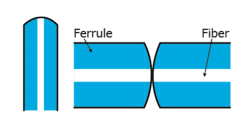
Trivia : Regarding connector ferrule polishing
The connector ferrule polishing method we use involves polishing the ferrule into a spherical shape. This enables stable connections with low reflection and low insertion loss. Furthermore, special polishing can achieve even lower reflection.
As standard specifications, UPC (Ultra Physical Contact) polishing is adopted for single-mode, and PC polishing is adopted for multi-mode.
Ferrule Polishing
Number of Cores for the Fiber Optic Cables
1-Core (Single) Fiber Optic Cables
1-core (Single) type is the most popular optical fiber cable.
The single-core type, also known as simplex communication, uses one fiber and transfers data in a single direction.
It is suitable for one-way communication such as sending traffic or packets, and transmitting to data centers or control rooms, offering low-cost and high-speed communication.

2-Core (Zipcord) Fiber Optic Cables
The 2-core type bundles two optical fiber cables and has two connectors attached.
Because the two fibers are grouped together and resemble eyeglasses, it is also called “Zipcord”. The 2-core type, also known as duplex communication, uses two fibers for bidirectional data transfer. It is ideal for two-way communication such as between servers, switching hubs, and data centers.
For long lengths, on-site installation can be difficult, so the “bundled-cord type” is preferred.

4-core (Fan-out) Fiber Optic Cables
Fan-out refers to a cable where a single multi-core cable “branches out” into multiple thin cables (fan-shaped).
By bundling four optical fibers and attaching four connectors, it is called the 4-core type. When one end is open, fusion splicing can be done per tape cord, enabling bulk 4-core splicing and significantly reducing installation time.
For long lengths, on-site installation is difficult, so the “bundled-cord type” described later is preferred.

Bundled (2 / 4-core)
Fiber Optic Cables
The bundled-cord type optical fiber cable has a tension member in the center, making it well-suited for on-site installation over long distances.
Unlike 2-core (zipcode) or 4-core (fan-out) cables, each multi-core unit is consolidated into a single assembly with a filler.

Flat (V-Groove) (2-core) Fiber Optic Cables
The flat-type optical fiber cable has a tension member in the center, making it well-suited for long-length on-site installation.
Additionally, in the 2-core version, the cores are wrapped in a flame-resistant sheath, and V-groove rip seams are provided on both the left and right sides.

Trivia : Non-catalog Fiber Optic Cables
Although it is outside the standard catalog, we can also accommodate configurations other than single-core, 2-core, and 4-core.
Please feel free to contact us first for more details.

Single Mode vs Multi Mode
Optical fiber consists of a three-layer structure (core/cladding/coating), and light travels through the core.
There are two types: single-mode and multi-mode. Single-mode has a smaller core, while multi-mode has a larger core.
Single mode
Single-mode carries one light signal at a time, enabling higher communication speeds and making it suitable for long-distance applications over 40 km.
Because it supports high-capacity, stable data transmission, it is ideal for long-range, wide-bandwidth network links across a broad spectrum of uses, including CATV, campus backbones, telecommunications, and large enterprises.
The glass core is much thinner than that of multi-mode.
Multi mode
Multi-mode can transmit more data in a short time, but due to its higher dispersion and attenuation, it is intended for short-distance applications.
Its communication speed is lower and maximum distance is shorter, making it optimal for low-capacity, short-range uses such as general data and voice.
It is easier to connect than single-mode.
Multi-mode is available in OM1 to OM5 lineup.
Note: The 4-core fan-out optical fiber cable does not offer OM5 in its lineup.
Note: Standard outer jacket colors are SM: yellow, OM1: orange, OM2: jade green, OM3: aqua, OM4: aqua, OM5: lime green.

Fiber Optic Cables: FAQs
QHow should I choose between single-mode and multi-mode fiber?
QHow should I choose between single-mode and multi-mode fiber?
Single-mode fiber is suitable for long-distance and high-speed transmission, while multi-mode fiber is ideal for short-distance and cost-sensitive applications. Choose based on transmission distance, required bandwidth, and system compatibility.
QWhat is the difference between SC and LC connectors?
QWhat is the difference between SC and LC connectors?
SC connectors are larger and easier to handle, commonly used in telecom and general applications. LC connectors are smaller and allow higher port density, making them ideal for data centers and compact equipment.
QCan I purchase just one fiber optic cable?
QCan I purchase just one fiber optic cable?
Yes, many fiber optic cables are available for single-unit purchase. Minimum order quantities may vary depending on the product type, so please check individual product pages for details.
QIs length customization possible?
QIs length customization possible?
Yes, custom cable lengths are available for many products. You can specify the required length to match your installation environment and reduce excess cable management.
QCan the connectors on both ends be different types?
QCan the connectors on both ends be different types?
Yes, fiber optic cables can be configured with different connector types on each end, such as SC to LC or LC to ST. This allows flexible connections between different devices and systems.
QWhat is the difference between simplex and duplex fiber optic cables?
QWhat is the difference between simplex and duplex fiber optic cables?
Simplex cables have a single fiber core and are used for one-way transmission. Duplex cables contain two fibers, allowing simultaneous bidirectional communication, which is common in most networking applications.
QWhat factors should I consider when choosing a fiber optic cable?
QWhat factors should I consider when choosing a fiber optic cable?
Key factors include connector type, number of cores, cable structure, and transmission mode (single-mode or multi-mode). These elements determine compatibility, performance, and installation requirements.
Purchase Guide
Tyclon coaxial connectors and processed coaxial cable products can be purchased directly online using a variety of credit cards.