

1.0 mm RF Connectors Guide: Types, and Structure
What are 1.0mm RF Connectors?
The 1.0 mm RF connector is an ultra-precision coaxial connector designed for extremely high-frequency applications up to 110 GHz. It features a 50 Ω impedance and a threaded coupling mechanism, ensuring stable signal transmission and reliable connections.
Due to its smaller size and unique mechanical interface, it is not compatible with 1.85 mm, 2.4 mm, 2.92 mm, 3.5 mm, or SMA connectors. This makes it suitable for advanced test and measurement environments where maximum frequency performance and accuracy are required.
Compatibility and Usage Range
1.0 mm RF connectors are ultra-precision miniature connectors designed for
extremely high-frequency measurements up to 110 GHz.
They are not compatible with 1.85 mm (V), 2.4 mm, 2.92 mm (K), 3.5 mm, or SMA connectors
because of their smaller geometry and different interface structure.
The 1.0 mm series uses a 50 Ω impedance and threaded coupling to ensure reliable connections
for millimeter-wave and 110 GHz applications where absolute precision is required.
Browse 1.0 mm RF Connectors by Product Type
Find 1.0mm RF connectors by type and quickly navigate to the right product category.
Can't find the right 1.0mm RF connector? We're here to help.
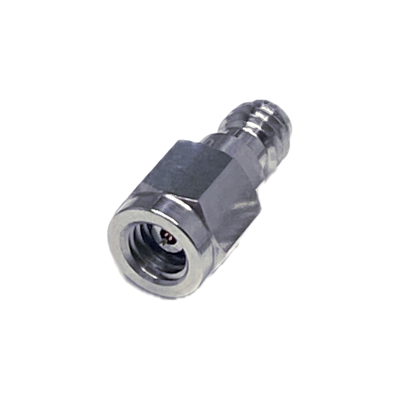

1.0mm RF Connector Features
Ultra-High Frequency Support
Operates reliably up to 110 GHz, making it ideal for cutting-edge millimeter-wave and high-frequency measurement applications.
Compact Precision Design
Extremely small form factor with tight mechanical tolerances ensures minimal signal loss and consistent performance.
Secure Screw Coupling
Threaded coupling mechanism provides stable, repeatable connections even under vibration or thermal stress.
1.0mm RF Connector Applications
Millimeter-Wave Measurements
Ideal for use in vector network analyzers and other test equipment requiring precision at frequencies up to 110 GHz.
High-Speed Digital and RF Modules
Used in advanced communication systems and semiconductor testing where ultra-high frequency performance is critical.
Research & Development
Commonly found in laboratories and development environments focused on 5G, 6G, radar, and aerospace technologies.
RF Connector Frequency Comparison
The following RF connectors are commonly used in high-frequency applications, each with different frequency ranges and characteristics.
1.0 mm: Up to 110 GHz
1.85 mm (V): Up to 67 GHz
2.4 mm: Up to 50 GHz
2.92 mm (K): Up to 40 GHz
3.5 mm: Up to 34 GHz
SMA: Up to 18 GHz
Higher-frequency connectors offer better performance but typically require more careful handling and precise alignment.
How to Choose 1.0 mm RF Connectors
1.0 mm RF connectors are designed for ultra-high-frequency applications where precision and performance are critical. Selecting the right connector requires careful consideration of frequency range, compatibility, and application conditions to ensure stable signal transmission.
Below are the key factors to help you choose the most suitable 1.0 mm RF connector for your system.
1. Confirm Frequency Requirements
1.0 mm RF connectors are designed for extremely high-frequency applications, typically used in millimeter-wave testing and precision measurement environments. Ensure the connector supports the required frequency range of your system.
2. Check Interface Compatibility
Verify that the connector matches the interface of your equipment, adapters, and cables. Even slight mismatches in high-frequency systems can degrade performance and cause signal loss.
3. Select the Appropriate Cable Type
Choose connectors that are compatible with the cable type used in your application, such as semi-rigid or flexible coaxial cables. Proper matching helps maintain signal integrity and mechanical stability.
4. Consider Mounting Style and Application
Depending on the application, you may need cable connectors, panel-mount types, or adapters. Selecting the correct form factor improves installation efficiency and usability.
5. Review Key Specifications
Check specifications such as impedance, frequency performance, durability, and application suitability. For demanding environments like laboratory testing or advanced communications, precise specifications are essential.
Need a custom 1.0 mm cable solution?
We support custom 1.0 mm RF cable assemblies for high-frequency applications.
Tell us your specifications, and our team will help you find the best solution.
1.0 mm vs 1.85 mm V RF Connectors
1.0 mm and 1.85 mm (V) RF connectors are designed for high-frequency applications but differ in performance and durability.
1.0 mm connectors support ultra-high frequencies (up to 110 GHz) but require careful handling due to their delicate structure.
1.85 mm connectors support up to 67 GHz and provide better mechanical durability, making them more practical for repeated use.
In general, 1.0 mm is used for ultra-high-frequency precision measurements, while 1.85 mm offers a more robust alternative for high-frequency testing.
1.0mm RF Connector Standards & Dimensions
Impedance
50 Ω
Coupling Method (Connection)
Threaded Coupling
Frequency Range
DC – 110 GHz
V.S.W.R.
1.5(Max.) at DC~110GHz
Materials
Stainless Steel
Note: The figures provided are typical values. For further details, please contact us.
1.0mm RF Connector FAQs
QWhat is the maximum frequency a 1.0mm connector can support?
QWhat is the maximum frequency a 1.0mm connector can support?
The 1.0mm connector is designed for operation up to 110 GHz, making it suitable for extremely high-frequency applications.
QIs the 1.0mm connector compatible with other connector types like 1.85mm or 2.4mm?
QIs the 1.0mm connector compatible with other connector types like 1.85mm or 2.4mm?
No. Due to its smaller size and different mechanical interface, the 1.0mm connector is not compatible with 1.85mm, 2.4mm, or other larger connectors.
> Between Series Adapters 1.0mm - 1.85mm
QWhat is the impedance of the 1.0mm connector?
QWhat is the impedance of the 1.0mm connector?
It features a standard 50Ω impedance, ensuring optimal signal transmission for RF and microwave systems.
QWhat type of coupling mechanism does the 1.0mm connector use?
QWhat type of coupling mechanism does the 1.0mm connector use?
It uses a screw-type (threaded) coupling mechanism that provides a secure and stable connection even in demanding environments.
QWhere is the 1.0mm connector commonly used?
QWhere is the 1.0mm connector commonly used?
It’s commonly used in millimeter-wave test equipment, high-speed communication systems, and advanced R&D applications such as 5G, 6G, and radar development.
Purchase Guide
Tyclon coaxial connectors and processed coaxial cable products can be purchased directly online using a variety of credit cards.